Home › Commercial Concrete Sealing and Surface Treatments
Extend the life of your concrete with commercial concrete sealing in Columbus, OH for floors, sidewalks, and exterior paving. We apply penetrating sealers, traffic coatings, and anti slip treatments tailored to your environment and use. Our prep and application process ensures good adhesion and consistent coverage across large areas. Protect against moisture, chemicals, and wear with the right surface treatment for your facility.
Superior Concrete Columbus provides professional commercial concrete sealing throughout Columbus, OH, Ohio and the surrounding area. Our licensed, insured crew delivers safe, clean, on-time work with a free estimate before anything begins. Call (380) 267-4943 or request your free quote.
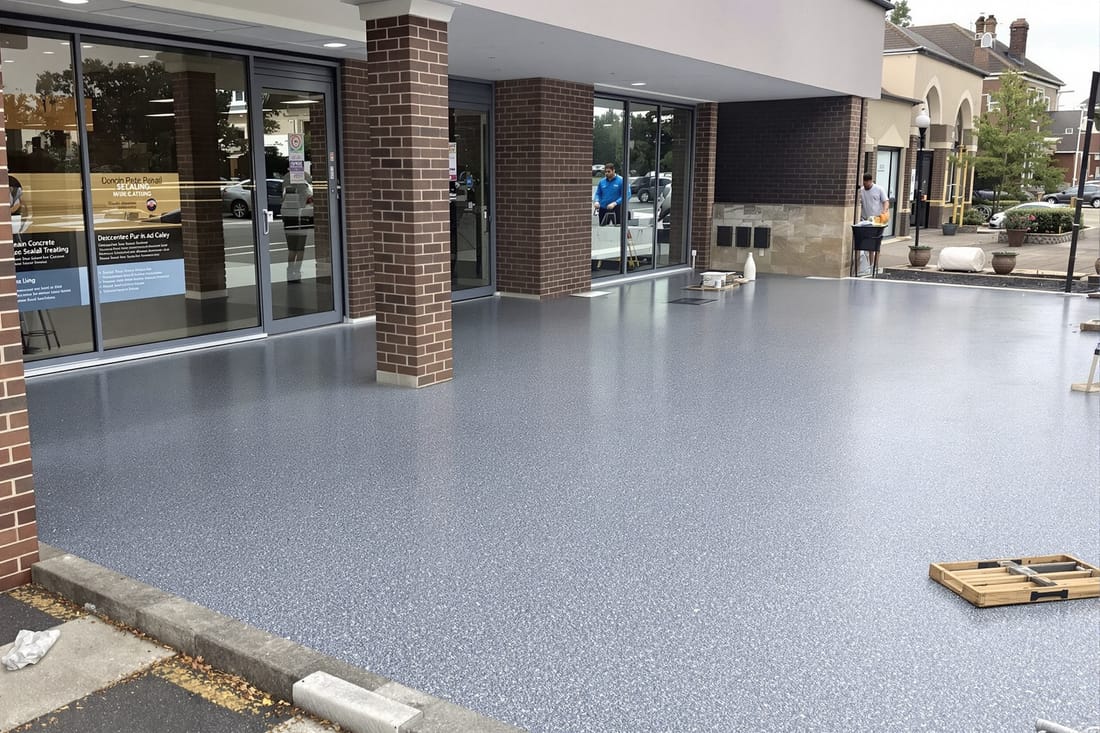
Commercial Concrete Sealing in Columbus, Built for Real-World Use
Commercial concrete in Columbus takes a beating. Freeze and thaw cycles, road salt, forklift traffic, pallet jacks, delivery trucks and constant foot traffic will break down unprotected concrete faster than most owners realize. Superior Concrete Columbus focuses on commercial concrete sealing and surface treatments that are chosen and installed for how your property is actually used, not just how it looks on day one.
When you call us, we start by asking about the space. Is it retail with high foot traffic, a loading dock with de-icing chemicals, a restaurant patio with grease and food spills, or a warehouse with forklifts turning in the same spots all day. The right sealer for a downtown Columbus storefront is not always the right product for a distribution center off I-270. We match the sealer and treatment to your use, weather exposure, cleaning habits and budget so you get a surface that performs and holds up, not just a shiny floor that wears out in a year.
Our work stays focused on practical benefits. Proper commercial concrete sealing resists salt and moisture, reduces dusting and slab erosion, cuts down cleaning time, and helps prevent scaling and spalling that lead to bigger structural repairs. We also consider slip resistance from the start, which is critical in Ohio winters when customers and employees track in snow and slush.
How We Seal and Treat Commercial Concrete Surfaces
Every job starts with inspection. We walk the property, tap test for hollow spots, look for scaling, pop-outs and previous coating failures, and check moisture levels, especially in ground-level and below-grade spaces. In Columbus, we pay close attention to areas near overhead doors and entrances where de-icing salt and meltwater collect.
Surface preparation is the most important step. For light to moderate contamination, we use commercial degreasers, mechanical scrubbing and high-pressure rinsing. For warehouses, garages and restaurants with heavy oil or grease, we may use hot water pressure washing, poultice degreasers or shot blasting to open the surface. If you have an existing failing sealer or coating, we mechanically grind or shot blast instead of relying only on chemical strippers so the new sealer bonds to sound concrete, not residue.
Cracks and defects are handled before sealing. Static cracks are routed and filled with semi-rigid epoxy or polyurea joint filler that can handle forklift wheels without tearing. Wide or moving cracks may need flexible joint sealants. Spalled or scaled areas are patched with polymer-modified repair mortars compatible with the planned sealer. We avoid quick fixes that look smooth for a month, then telegraph through a clear sealer and create a patchwork appearance.
Once the surface is clean, dry and repaired, we apply the chosen sealer or treatment in controlled coats. For penetrants, we typically use low-pressure sprayers and saturate the surface to refusal, then back roll to even out the application. For film-forming sealers, we spray and back roll or use microfiber applicators to avoid lap marks. On larger commercial slabs, we work in sections to keep wet edges and maintain a consistent finish. After application, we enforce cure times so traffic does not return too early. That is one of the biggest reasons cheap sealing jobs fail.
Choosing the Right Sealer and Treatment for Your Facility
There is no one-size-fits-all sealer for commercial concrete. Superior Concrete Columbus typically works with four main categories: penetrating sealers, acrylic film-forming sealers, high-performance urethane or epoxy systems, and densifiers or hardeners.
Penetrating sealers, like silane and siloxane blends, soak into the concrete and repel water and chlorides without changing the surface appearance much. These are ideal for outdoor sidewalks, parking decks, loading docks and exposed stairs around Columbus, especially where road salt splash is a concern. They are breathable, so moisture can escape from the slab, which is important in our climate with year-round humidity swings.
Acrylic film-forming sealers lay on top of the surface and provide a visible sheen. We use these where appearance matters, like retail entrances and decorative exterior flatwork. For commercial use, we favor industrial-grade, non-yellowing acrylics and often add fine aggregates for slip resistance. Acrylics are generally easier to recoat, which is useful for properties that want a fresh, clean look every few years.
High-performance urethanes and epoxies provide the most chemical and abrasion resistance. These are common in manufacturing, warehouses, fire stations and service bays. We choose specific systems based on expected chemical exposure, hot tire load, cleaning methods and whether you need USDA-acceptable surfaces. Often we use epoxy as a base with a urethane topcoat for better UV stability and wear.
Densifiers and hardeners chemically react within the concrete to increase surface hardness and reduce dusting. We often use these in combination with polishing for large retail or distribution areas where you want a low-maintenance surface that still reflects light and stays easy to clean. In some Columbus facilities, we pair densification with a penetrating sealer for extra salt and moisture protection near doors and dock areas.
What Affects Cost and Scheduling in Columbus, Ohio
Several factors drive the cost of commercial concrete sealing and surface treatments, and understanding them helps you plan and budget. The biggest cost drivers are surface condition, square footage, access, and the type of sealer or system selected.
Surface condition is first. Clean, relatively sound concrete that only needs light prep costs less to seal. Concrete that has heavy oil staining, adhesive residue, thick failing coatings or widespread spalling needs more aggressive preparation like grinding or shot blasting. That adds time, labor and equipment cost, but it is also what keeps your new system from peeling or delaminating a year later.
Square footage and layout matter. Large, open warehouses are more economical per square foot than a series of small rooms and tight corridors. Obstacles like racks, fixed equipment, islands and coolers require more hand work. Access is also critical. If we can bring in ride-on equipment, material handling is quicker. If we are restricted to small machines and manual application, production slows and labor costs rise.
Product choice affects both material and labor cost. Penetrating sealers and densifiers generally cost less than high-build epoxies or urethanes, but a higher-end system might be cheaper over a five to ten year window if it lasts longer in a harsh environment. With Columbus winters and de-icing salts, we often recommend not going with the cheapest option simply because the cost of early failure includes downtime, rework and potential safety issues.
Season and scheduling matter in Ohio. Outdoor work is best scheduled from late April through October, when temperatures and humidity levels are more predictable and we can meet product cure requirements. For indoor work, we can seal year-round, but in winter we coordinate heat, ventilation, and door usage so cold air does not slow curing or create condensation on the slab. We often schedule work in phases or over weekends and nights to keep your business operating, especially for retail, medical and logistics clients.
Common Problems, Local Conditions, and How We Prevent Failures
Around Columbus, the same issues show up again and again on unprotected or poorly sealed commercial concrete: salt damage near entry doors, scaling and flaking on exterior walks, peeling coatings in service bays, and slick surfaces where snow melt and cleaning water collect. Superior Concrete Columbus designs each sealing project to directly tackle these local realities.
Salt and freeze cycles are the biggest exterior threat. When water and chlorides penetrate the slab and then freeze, surface layers pop off and aggregate becomes exposed. To combat this, we favor breathable penetrating sealers with proven chloride screening for exterior walks, stairs and loading zones, and we specify realistic reapplication schedules. We also advise property managers on snow and ice practices, like using calcium or magnesium blends instead of straight rock salt in sensitive areas and avoiding piling salty snow right at the edge of walks.
Peeling and delamination are usually preparation or moisture problems, not product problems. Before we approve a coating system, we test for moisture vapor emission and relative humidity in the slab, particularly in older buildings and areas over unconditioned spaces. If readings are high, we can install moisture mitigation primers rated for that level of vapor, or shift to breathable systems that are more forgiving.
Slip resistance is a genuine liability concern in commercial spaces, especially in Ohio winters. We incorporate non-slip additives and texture into our sealers and coatings instead of treating it as an afterthought. For front entrances, we balance a clean, attractive finish with enough micro-texture so people in wet shoes have traction. For back-of-house, loading docks and kitchens, function comes first and we often use more aggressive textures.
Before you hire any contractor for commercial concrete sealing, ask them exactly how they will prep your surface, what system they are installing by brand and specification, how they will handle moisture, and what their plan is for maintaining slip resistance over time. We are happy to walk you through these details on site and give you options with clear pros and cons for Columbus conditions so you can make a practical choice that will last.